Cryptologist posted: "Cointelegraph is following the development of an entirely new blockchain from inception to mainnet and beyond through its series, Inside the Blockchain Developer's Mind. In previous parts, Andrew Levine of Koinos Group discussed some of the challenges the"
Cointelegraph is following the development of an entirely new blockchain from inception to mainnet and beyond through its series, Inside the Blockchain Developer's Mind. In previous parts, Andrew Levine of Koinos Group discussed some of the challenges the team has faced since identifying the key issues they intend to solve and outlined three of the "crises" that are holding back blockchain adoption: upgradeability, scalability, and governance.
Blockchain testnets are an interesting subject because they come in all shapes and sizes. So, in this post, my goal is to leverage my inside experience as the CEO of Koinos Group (developers of Koinos) to demystify testnets and perhaps give some insight into why they seem to have such an impact on price.
The most obvious place to start is with the name: testnet. The purpose of a testnet is to test a network. At a very high level, there are two "flavors" of testnet. The first is a testnet that is released prior to a mainnet (main network), and the second is a testnet that is released after a mainnet is already in operation. The functions these serve are similar, but the context in which they are released dramatically impacts the perception, and impact, of the release.
I'll start with the second kind of testnet because, in a way, this is the more straightforward context. When you're talking about existing networks like Bitcoin and Ethereum, testnets serve two primary functions. The first is that they are a live environment in which developers can test their decentralized applications. Every good developer knows that there's no such thing as perfect code, so testnets give developers an environment that is very similar to the "main chain" (e.g. Ethereum) in which they can test their code with effectively zero risk. Things running on a testnet are expected to break, and the tokens used are expected to be worthless.
So, testnets are an environment that enables decentralized application (DApp) developers to increase the value of their applications (i.e., make their apps better) precisely because there is no expectation of full functionality or wealth creation. In a sense, the value of a testnet stems from its worthlessness.
DApp developers vs. blockchain developers
But testnets have a two-sided nature, which brings us to the second function that testnets serve, and that function is to the benefit of, not the DApp developer, but the platform developer (in our case, the blockchain developer). One thing I have been surprised to see from my unique perspective is how commonly DApp developers are conflated with blockchain developers. Typically, people who write smart contracts are not blockchain developers, and blockchain developers generally spend very little time writing smart contracts.
Ironically, Koinos is throwing a huge wrench in this distinction because its entire system is implemented as smart contracts! Since Koinos smart contracts are upgradeable, this means that any feature can be added to the blockchain without a hard fork, but it also means that the people developing the blockchain (like members of the Koinos Group) are using and developing the very same toolchain and toolkit that developers will use to build their DApps. But this is a feature that is totally unique to Koinos, so we can put that aside for the sake of this discussion.
In every other blockchain, the blockchain developers have to develop updates in whatever programming language the blockchain is written in (C++, Rust, Haskell, etc.), and they are working on a very large and complicated system called a "monolithic architecture." Within monolithic architectures, changing any part of the system can impact any other part of the system, so the risk of making changes is that much higher.
Blockchain developers also need a live environment with low stakes that they can use to test out their changes and see what breaks. Like application developers, they want this environment to be as close to the real network as possible, which means that they want their code to interact with code that application developers will be running as well.
Two sides of testnets
This reveals the two-sided aspect of testnets. They enable both the developers of applications and the developers of platforms to interact with one another and safely test their code in as close to a live environment as possible, but with very low stakes. This enables both groups to improve their products and make them more valuable to their users.
Now we can start to see why testnets seem to have such an impact on token price. If we assume that price is a function of value, and that testnets help developers increase the value of their products, then price impact should be expected. The problem is that this correlation has led to several undesirable outcomes. Projects will often release a "testnet" that has no utility to developers for the sole purpose of boosting their token price. Unfortunately, many people will see the testnet announcement and just assume that something valuable has been released, and so the act will have the desired effect on the price.
Testnets before mainnet
Up until now, I've been focusing on the utility of testnets in the context of existing blockchains, which is that they create a safe space for application developers to test their applications and for blockchain developers to test upgrades to the underlying platform. This will help you understand the other important context in which testnets are released, which is prior to the release of the mainnet.
Once again, testing is the primary objective, but the focus is far more on the system itself, as it has never before been operational. Of course, since it is new, there won't be any applications running on it anyway. Now the situation is more one-sided. The majority of the people working with the codebase will be blockchain developers, and the goal is to get the platform to a place where developers want to actually build on it.
The first requirement developers will have is that the platform is proven to be sufficiently safe, and that should be the prime directive behind the specific tests that are run. Assuming developers are convinced that the platform is sufficiently safe, then they'll need to be educated on how to use the platform. In other words, the testnet must be thought of as an educational tool that enables developers to gain a deeper understanding of how they will be able to use the platform while they are also helping to test the security of the network.
Finally, as they are testing the network and learning how to use it, they will inevitably find places where the platform could be improved — important libraries might be needed, or important documentation might be needed to help them understand the system. This information is invaluable feedback that the platform developers absolutely have to use to make the platform better before mainnet implementations are finalized.
Computer networks have become a major part of our lives whether we realize it or not, and they are only increasing in importance. Testnets are a critical step in the process of releasing new and innovative computer networks that can add ever-increasing value to our lives. Hopefully, by gaining a deeper understanding of the nuances of testnets and the important contexts in which they are released, you are now better equipped to evaluate specific testnet releases and whether they are being designed and launched for the right reasons.
This article does not contain investment advice or recommendations. Every investment and trading move involves risk, and readers should conduct their own research when making a decision.
The views, thoughts and opinions expressed here are the author's alone and do not necessarily reflect or represent the views and opinions of Cointelegraph.
Andrew Levine is the CEO of Koinos Group, where he and the former development team behind the Steem blockchain build blockchain-based solutions that empower people to take ownership and control over their digital selves. Their foundational product is Koinos, a high-performance blockchain built on an entirely new framework architected to give developers the features they need in order to deliver the user experiences necessary to spread blockchain adoption to the masses.
Koinos Group recently released version 2 of their testnet, which features stability improvements, their mana fee-less transactions system and a contract development toolkit that will allow developers to build and run smart contracts on Koinos.
Cryptologist posted: "Starting Today, Wednesday October 27, transfer KRL, LCX, SUKU and TRAC into your Coinbase Pro account ahead of trading. Support for KRL, LCX, SUKU and TRAC will generally be available in Coinbase's supported jurisdictions with certain exceptions as indica"
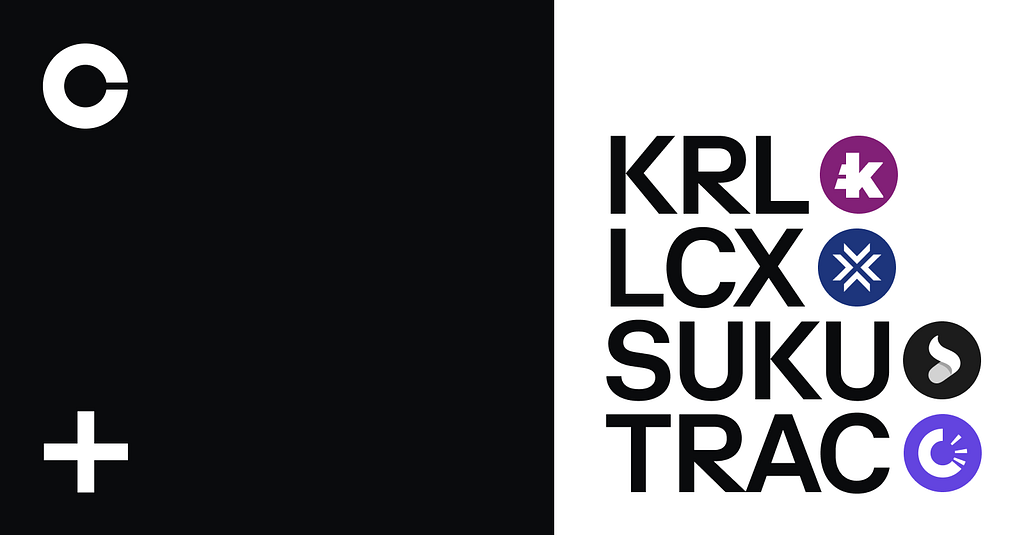
Starting Today, Wednesday October 27, transfer KRL, LCX, SUKU and TRAC into your Coinbase Pro account ahead of trading. Support for KRL, LCX, SUKU and TRAC will generally be available in Coinbase's supported jurisdictions with certain exceptions as indicated in each asset page here. Trading will begin on or after 9AM Pacific Time (PT) Thursday October 28, if liquidity conditions are met.
Starting Today, Wednesday October 27 we will begin accepting inbound transfers of KRL, LCX, SUKU and TRAC to Coinbase Pro. Trading will begin on or after 9AM Pacific Time (PT) Thursday October 28, if liquidity conditions are met.
Once sufficient supply of KRL, LCX, SUKU and TRAC is established on the platform, trading on our KRL-USD, KRL-USDT, KRL-EUR, LCX-USD, LCX-USDT, LCX-EUR, SUKU-USD, SUKU-USDT, SUKU-EUR, TRAC-USD, TRAC-USDT and TRAC-EUR order books will launch in three phases, post-only, limit-only and full trading. If at any point one of the new order books does not meet our assessment for a healthy and orderly market, we may keep the book in one state for a longer period of time or suspend trading as per our Trading Rules.
We will publish tweets from our Coinbase Pro Twitter account as each order book moves through the phases.
Kryll (KRL) is an Ethereum token that powers Kryll, a platform for automated trading strategies. Kryll users can browse, create, and backtest trading strategies while using KRL to pay for their activity on the platform.
LCX (LCX) is an Ethereum token used to pay for fees on LCX Exchange, a centralized exchange for security tokens, token sales, and cryptocurrencies. LCX is also used to power other LCX products such as the LCX Terminal, which lets users trade across multiple exchanges, and the DeFi Terminal, which offers advanced charting and limit orders built on top of Uniswap.
SUKU (SUKU) is an Ethereum token that powers the SUKU Platform, a blockchain-based ecosystem that aims to make supply chains more transparent. SUKU tokens can be used for platform governance and to reward users and SUKU node operators. SUKU Platform is also developing applications for DeFi lending and NFT marketplaces.
OriginTrail (TRAC) is an Ethereum token that powers OriginTrail, which describes itself as a "decentralized knowledge graph." OriginTrail is used to discover, manage, and store data for everything from supply chain tracking to verifying art, diplomas, and business certifications. TRAC token is used to pay for data processing and storage on the network.
KRL, LCX, SUKU and TRAC are not yet available on Coinbase.com or via our Consumer mobile apps. We will make a separate announcement if and when this support is added.
You can sign up for a Coinbase Pro account here to start trading. For more information on trading KRL, LCX, SUKU and TRAC on Coinbase Pro, visit our support page.
### Please note: Coinbase Ventures may be an investor in the crypto projects mentioned here, and additionally, Coinbase may hold such tokens on its balance sheet for operational purposes. A list of Coinbase Ventures investments is available at https://ventures.coinbase.com/. Coinbase intends to maintain its investment in these entities for the foreseeable future and maintains internal policies that address the timing of permissible disposition of any related digital assets, if applicable. All assets, regardless of whether Coinbase Ventures holds an investor or Coinbase holds for operational purposes, are subject to the same strict review guidelines and review process. This website contains links to third-party websites or other content for information purposes only ("Third-Party Sites"). The Third-Party Sites are not under the control of Coinbase, Inc., and its affiliates ("Coinbase"), and Coinbase is not responsible for the content of any Third-Party Site, including without limitation any link contained in a Third-Party Site, or any changes or updates to a Third-Party Site. Coinbase is not responsible for webcasting or any other form of transmission received from any Third-Party Site. Coinbase is providing these links to you only as a convenience, and the inclusion of any link does not imply endorsement, approval or recommendation by Coinbase of the site or any association with its operators.
Crypto is a new type of asset. Besides potential day to day or hour to hour volatility, each crypto asset has unique features. Make sure you research and understand individual assets before you transact.
Cryptologist posted: "Data is the most important element of today's information-driven businesses. The better decision-makers understand their staff's requirements, industry developments, and client expectations. Also, it can more strategically plan future growth. This need ha"
Data is the most important element of today's information-driven businesses. The better decision-makers understand their staff's requirements, industry developments, and client expectations. Also, it can more strategically plan future growth. This need has fuelled massive development in decentralized cloud storage.
StorX aspires to be a decentralized cloud storage leader. Convenient enterprise-grade storage options like Google Drive are combined with solid open source technologies. It wants to democratize the monopolized cloud service industry. Its technology allows consumers to rent storage from individual farms rather than a centralized service provider. Moreover, it is an open-source initiative.
StorX node is for you if you want to put your empty disc space to work, contribute to the future of cloud storage, and be paid. StorX is a decentralized cloud storage service backed by the XinFin blockchain network. Anyone may run a node on the network and earn SRX tokens. The network integrates Google Drive with dependable open source technologies. It also promotes good performers and removes bad performers. It uses an AI system to assess node reputation.
The User, The Star, and The Satellites are the three core parts of StorX Ecosystems. The SRX token is a payment currency on the StorX platform. The user hosting data must pay in SRX, and the farmer hosting node will receive it in SRX.
Node Operators
The primary role is to help the network as storage node operators establish storage supplies. The inclusion of nodes in the network and their reputation is based on node reputation.
Node Reputation
StorX relies on a scalable and robust node reputation system. The sophisticated StorX AI system quantifies the Node's stability and performance. The system employs reputation measurements to exclude adversaries from the network, enhancing security, dependability, and durability.
Network Node Inclusion
The network offers a unique procedure for adding additional nodes. When a storage node enters the network, its reputation is set to 0. Whenever someone uploads a new file to the StorX network, the Satellite adds unvetted nodes to the target list while maintaining file durability. Satellite is a sequence of machine learning methods that improve payload distribution on a node.
Unvetted nodes must present proof-of-work to store data. After vetting, the Node is selected for broad upload. A node's reputation rises over time as it stores data and produces proof-of-work for it.
Node Selection
The standard storage nodes are chosen based on throughput, latency, dependability, uptime history, and geographic location. As part of the load-balancing process, all uploads are forwarded to qualified nodes, with a preference for recommended nodes but a possibility for any qualified node. The system monitors the Node's activity. Its reputation score grows over time if it gives download statistics, passes audits, and maintains uptime.
Rewards, Penalties, and Node Reputation
Node reputation is used to determine a node wallet's reward eligibility. The StorX Governance team has a good reputation. The mark refers to the Node's reputation as an active network member eligible for $SRX incentives. The StorX Governance team may alter this barrier to accommodate the growing network. Penalties for low-reputation nodes are in the amount of $SRX tokens. AI automatically deducts token staking/reward penalties. The whole procedure is kept within the smart contract for community accountability.
The StorX Ecosystem functions flawlessly when Storage Node operators maintain Good Node Reputation. Nodes that perform poorly may be disqualified, resulting in no "hosting and staking incentives". Staked SRX may be burnt as a punishment if it repeatedly harms StorX Storage Network.
Reasons Backing Good Node Reputation:
Provide a solid cloud Infrastructure
$SRX Stake increases "Good" Node Reputation
Ensure 100% uptime
Always keep nodes updated with the newest patches and OS updates.
Causes for a Node's Poor Reputation:
Incorrect node configuration, such as not accessible on the specified port.
Node response time
Low traffic on primary app
If you correctly configure the Node, it will be considered for storage, and its reputation will rise.
Maintaining a Good Reputation
A robust node satisfies all of the readme's criteria. Its reputation will grow as it stays active in the network. Because a node's reputation is based on its contribution to the network, greater network activity means a higher reputation. Node owners (farmers) are asked to distribute and utilize the StorX App as much as possible to build a reputation. Access the farmer dashboard to verify repute. The team is working on a dedicated dashboard to show the Node's data.
Open Community
One of the other plus points, StorX is always open for input and ideas to improve the farm node's reputation-based reward and punishment mechanism. They consider recommendations seriously as it will help establish a better and more simplified node reputation environment.
Conclusion
To summarize and conclude, in simple terms, on the StorX mainnet, SRX is a utility token that drives the StorX data storage marketplace. Operators need to set up Node and earn SRX. Also, save data and pay using SRX. Node operators need to maintain Good Node Reputation to ensure StorX Ecosystem works perfectly and operators earn through the Node and its reputation.




No comments:
Post a Comment