Crypto Harry posted: "On August 10, the United States Senate voted to pass a $1 trillion bill to revitalize America's infrastructure. From the standpoint of the crypto community, miners in particular, the Senate's foray into crypto legislation has been a disaster. Unless the l"
On August 10, the United States Senate voted to pass a $1 trillion bill to revitalize America's infrastructure. From the standpoint of the crypto community, miners in particular, the Senate's foray into crypto legislation has been a disaster. Unless the language defining brokers in the bill is clarified, it will singlehandedly thwart the growth of a domestic industry just as it is taking off.
As written, the bill allows for multiple interpretations of the term "broker." In the English language, there is no real controversy — or ambiguity — about what a broker does. According to Merriam-Webster's online dictionary, a broker is "one who acts as an intermediary: such as […] an agent who negotiates contracts of purchase and sale (as of real estate, commodities, or securities)." In traditional finance, brokers purchase and sell financial assets, such as stock and bonds, for their clients. Compare this with miners of Bitcoin (BTC), the dominant cryptocurrency. In contrast to brokers, Bitcoin miners solve cryptographic puzzles to validate new blocks, an essential activity for the Bitcoin network to operate. The miners receive Bitcoin as compensation for providing this computation service. Thus, they definitively are not brokers.
Unfortunately, the bill passed by the Senate contains overly broad and ambiguous language in its definition of "broker":
"Any person who (for consideration) is responsible for regularly providing any service effectuating transfers of digital assets on behalf of another person."
A threat to the BTC mining industry
In defining a broker this way, the bill requires mining companies to provide the same information to regulators that a stockbroker is required to provide, such as taxable net gain or loss, identity of the buyer/seller, the amount of the transaction and the location of the transaction. Simply put, miners have no way to collect this information because they only validate the blocks, not the information inside them. As such, if miners are considered brokers under this language, they would not be able to comply with the law. This uncertainty, intentional or not, poses an existential threat to the U.S. Bitcoin mining industry.
Crypto mining is vital for the functionality of proof-of-work cryptocurrency networks, the most notable being Bitcoin. Without mining, many of the revolutionary aspects of blockchain technology would not be possible. For example, aspects such as decentralization, accountability, verification and security are all made possible through mining. Without mining, there is no Bitcoin network.
Currently, the U.S. crypto mining industry is expanding. Features such as a stable government, cheap energy, excess land and a strong economy have made the country an attractive location for crypto miners. Bitcoin adoption is increasing, both among individuals and companies — as adoption takes hold, the U.S. industry is growing employment for financial professionals, software developers, engineers, marketers and facilities managers.
Many Americans hold Bitcoin balances and many individuals globally use Bitcoin to transfer earnings and wealth to families in different countries. Citizens of the countries with mismanaged currencies are trusting the Bitcoin network to maintain their purchasing power in the face of rapidly depreciating currencies. In short, the United States is an important player in a rapidly growing market that provides value to millions of people. And this role is expanding as China, which does not trust the decentralized, market-based ethos of Bitcoin, has moved to shut down mining inside its borders.
The Senate bill snatches defeat from the jaws of victory. Just as U.S. crypto mining is set to expand exponentially, the uncertainty caused by the bill's ambiguous language is stymieing investment. At our company, we have experienced this firsthand. Employment, wages and resulting consumer spending have been put on hold because of the bill — a sad irony given that the purpose of the bill is to support economic growth and job creation.
Unless the language in the bill is changed to clarify that miners are not brokers, the United States will miss out on several benefits that crypto mining offers, such as grid stability, capitalization of stranded energy, and the repurposing of wasted energy. Crypto mining enhances grid stability by helping utilities balance supply and demand. Miners maximize profits when energy is cheap and plentiful, providing utilities revenues when prices are low. When energy demand increases and prices rise, crypto miners stop mining, which releases energy supplies to the grid and brings down prices for other users.
Crypto mining and energy consumption
The narrative that crypto mining wastes energy has it backwards. Crypto mining does not waste energy but, instead, makes use of energy that would otherwise be wasted. Energy producers do not finetune their output to perfectly match supply and demand. Energy is frequently produced and not used because of mismatched supply and demand, and/or is lost due to transmission over long distances.
The most cost-effective miners are located close to the utility's power. The Bitcoin these miners "produce" does not create incremental demand for additional energy, but rather uses energy that would be produced anyway. Thus, in addition to providing investment and jobs to local economies, crypto miners promote a more robust grid, reduce energy waste and generate revenues that utilities can use to transition operations off of fossil fuels and into renewable energy sources.
There is still hope
Given these and other benefits, the Senate's broadside against crypto mining is both puzzling and deflating. But there is still a chance that the U.S. House of Representatives rectifies the unfortunate language. Although the proposed amendments to the Senate infrastructure bill were not adopted, the fact that it was offered at all demonstrates that there is some support for crypto mining in the Senate. The House of Representatives may pass a different infrastructure bill. If this happens, it is possible that House and Senate negotiators could produce a final bill clarifying that crypto miners are not brokers. This would be the best outcome for the industry and the economy.
Crypto mining is going to take place somewhere because demand for Bitcoin and other cryptocurrencies is increasing. It would be better for the U.S. economy and the environment if the crypto mining industry continues to expand domestically. The first step to making the U.S. a leader in crypto mining is to clarify that miners are not brokers. The failure to do so will have long-lasting ramifications, preventing the United States from becoming a leading player in this fast-growing industry.
This article does not contain investment advice or recommendations. Every investment and trading move involves risk, and readers should conduct their own research when making a decision.
The views, thoughts and opinions expressed here are the author's alone and do not necessarily reflect or represent the views and opinions of Cointelegraph.
William Szamosszegi is the CEO and founder of Sazmining Inc., a cryptocurrency mining developer and consulting firm, and host of Everything Crypto Mining: The Sazmining Podcast. He is bullish on Bitcoin's future as the dominant global digital reserve asset and believes Bitcoin is the solution for layer-one, sound money. William grew up in Maryland and studied psychology and management at Bucknell University. William spends his spare time working out, seeing friends and reading.
Crypto Harry posted: "The run-up in the Bitcoin (BTC) price toward $50,000 last week risks exhaustion due to a mismatch between the cryptocurrency's price and momentum trends.So it appears the Bitcoin's price and relative strength index (RSI) have been moving in the opposite d"
The run-up in the Bitcoin (BTC) price toward $50,000 last week risks exhaustion due to a mismatch between the cryptocurrency's price and momentum trends.
So it appears the Bitcoin's price and relative strength index (RSI) have been moving in the opposite direction since late July. In doing so, even a strong push higher in the BTC/USD bids has coincided with lower peaks in momentum, suggesting that the pair's upside momentum is weakening out.
Bearish divergence
A normal RSI momentum tends to tail the price action. That said, it rises when the price rises and falls when the price drops. But in some cases, the RSI deviates from pursuing the price trends, leading to a so-called RSI divergence.
Technical analysts consider RSI divergence as a powerful signal to spot price reversals. For instance, a bullish divergence, wherein the price falls and RSI rises, prompts traders to buy the asset in anticipation of a rebound. Similarly, a bearish divergence—featuring rising prices and falling RSI—prompts traders to take profits at the top while expecting a pullback.
The Bitcoin daily chart below shows the cryptocurrency in bearish divergence.
The downside signal appears as Bitcoin struggles to break bullish above $50,000. As of Sunday, the benchmark cryptocurrency was trading at $48,387, or 4.19% lower from its three-month high of $50,505, achieved on Aug. 3, following a similar 72.36% upside boom.
Good morning!$BTC has broken the ltf bullish structure. Main target remains $38k as long as it stays below $50k
If it finally drops to that level, buy as much as you can
On the other hand, Bitcoin's daily RSI initially rallied in sync with prices but topped out on July 30, which was way ahead of price, hitting $50,505. Since July 30, the Bitcoin price formed a sequence of higher highs while RSI printed lower highs, suggesting a weakening upside momentum.
A similar bearish divergence between January and April 2021 was instrumental in predicting a Bitcoin price drop, as shown in the chart below.
Bitcoin price-RSI divergence from January-April 2021 period. Source: TradingView.com
Bullish indicators
The bearish divergence signal comes as Bitcoin holds strongly above $30,000, amidst anticipation that it would become a hedge of choice among accredited investors against inflationary pressures.
The perception has led many analysts, including investment researcher Lyn Alden and Fundstrat CEO Tom Lee, to predict a $100,000 valuation for the cryptocurrency in 2021.
On Friday, Bitcoin price shot upward by $1,500 in an hour after Federal Reserve Chairman Jerome Powell presented a pro-inflation, dovish policy outlook at this year's Jackson Hole symposium.
As a result, the biggest bullish indicator for Bitcoin remains the Fed's aggressive $120 billion a month asset purchase program, coupled with its near-zero interest rate policy.
The strong fundamental has prompted technical analysts to envision a long-term uptrend in the Bitcoin market. Namely, independent market analyst Teddy Cleps presented a bullish outlook for the cryptocurrency, based on key wave support that acts as an accumulation area for traders.
Similarly, Ryan Clark, another market analyst, noted that Bitcoin has been merely consolidating below $50,000 just like when it was trading below $24,000 before the December 2020's bullish breakout.
Bitcoin under 50k level acting like when it was under the 24k level.
On the other hand, TraderXO noted that Bitcoin could still fall towards the $39,000-40,000 area but remained convinced that the cryptocurrency would log an attractive rebound from the lower range.
The analyst marked Bitcoin's all-time high near $65,000 as its long-term upside target.
The views and opinions expressed here are solely those of the author and do not necessarily reflect the views of Cointelegraph.com. Every investment and trading move involves risk, you should conduct your own research when making a decision.
Crypto Harry posted: "Digital wallets are software constructs that mimic physical wallets and provide the functionality of storing, using and categorizing payment instruments. The journey of digital wallets started with payments and morphed to other forms of stubs such as digi"
Digital wallets are software constructs that mimic physical wallets and provide the functionality of storing, using and categorizing payment instruments. The journey of digital wallets started with payments and morphed to other forms of stubs such as digital passes, tickets and boarding passes. However, crypto wallets attempt to redefine the digital wallet landscape as something more than safe storage of payment and crypto instruments.
With more than 100 crypto wallets and growing, this sector in the cryptosphere is getting crowded and adding further complexity to an already fragmented blockchain and digital asset space. As I study this space and try to make sense of the complexity of new blockchains, layer-one protocols decentralized finance (DeFi) and nonfungible token (NFT) projects emerging with exponential growth, I think crypto wallets will be the next battlefront as the wars of layer-one protocols eventually cool down. The core issues of scale, security and speed of transaction processing and layer-two protocol consolidate and morph as layer-one superiority aims for processing efficiency and security. Crypto wallets will not only provide an avenue to gain wallet share but will also represent the battle for mind share.
Today, most crypto wallets provide software constructs that, for the most part, provide the following services at a very basic level:
Store public and private keys;
Interact with various layer-one blockchains;
Send and receive crypto assets and cryptocurrencies;
Monitor balance.
Crypto wallets should be more than better key management
In my opinion, we need to broaden the definition of a crypto wallet and view it as an avenue to participate in the crypto economy. It can provide the wallet holder with a choice framework for participating in a regulated network that emphasizes digital identity and requires third-party validation, for example, Know Your Customer.
At the same time, it also can be part of emerging networks that preserve anonymity and emphasize the confidentiality and privacy preservation of the participants. This choice framework will enable the regulatory and compliance conversation, shifting towards the network and activities as opposed to individuals, just like the choice frameworks our current wallets provide at an analog level.
A wallet would be modeled to be an extension of our identity constructs within the current identity frameworks that are issued by authoritative agents (like a government-issued ID) to an evolving digital identity that represents our (credit) history, reputation and incentive-driven history. It would not only promote transparency and good behavior but also preserve privacy. The notion of identity is important because digital identity (which today is tied to every wallet and every network) is foundational technology to ensure the trade, trust and ownership of digital assets.
A wallet's ability to control participation and the choice framework for enabling users to choose wallet attributes will allow for a flexible design and encourage participation. These wallets are traditionally containers of all types of asset classes such as NFTs, DeFi assets, cryptocurrencies and crypto assets. In addition, they also contain existing payment instruments, stored value accounts and other forms of digital stubs, allowing participation and inclusion by a registration process for existing financial services platforms and both current and future blockchain and crypto-economic driven networks. The registration could involve either sharing crypto primitives, say a public key, or providing the wallet identified for traditional centralized platforms.
In the Web 3.0 era
The question we should be asking is how to design a crypto wallet that can be a conduit to a new decentralized internet (Web 3.0) and the entire cryptosphere, and replace and reform our relationship with current services and institutions.
The new design of these wallets should enable engagement in (crypto) economic activities — whether Web 3.0 or otherwise — for example, file storage, NFT custody and simply storing data or instruments that let a wallet serve as an account receptacle for all our earnings and engagements in the cryptosphere and existing institutions.
Whereas website payment standards and web payments at World Wide Web Consortium (W3C) aim to define technology standards. MetaMask, although confined to Ethereum (layer-one protocol), provides an impressive view into what could be a clean way to provide a browser and wallet integration, known as a browlet. MetaMask has been doing this since early 2016 and now defines institutional access with MetaMask Institutional (MMI). Currently, the technology design of wallets focuses on layer-one or platform-specific wallets and key management, which is necessary for the durability and long-lasting growth of Web 3.0. With a model like MetaMask's, however, wallet provisioning can be a new business model.
Institutional context and considerations — An institutional wallet?
Exponential growth in digital assets and related ecosystems, such as decentralized finance, native crypto assets and NFTs, has not only given rise to massive innovation in technology and finance products but also attracted the attention of many innovators, technologists, investors and, more recently, institutional investors.
While blockchain, as a distributed ledger infrastructure and transaction processing system, aims for efficiency for dematerialized assets (assets in a ledger entry), the emergence of crypto and digital assets changes the landscape and the participants, essentially altering the market infrastructure. Thus, it makes digital (and crypto) assets unique and differentiated due not only to inherent characteristics of the assets but also to the resulting changes in the digital (crypto) assets market infrastructure. Digital (crypto) assets are generally bearer assets, and the claim to these assets is generally governed by a public-private key infrastructure. Digital assets are bearer assets, raising implications for trading and safeguarding, and surfacing considerations for institutional asset managers looking to allocate capital to a digital asset fund.
The notion of a wallet in an institutional context has a few more nuances and considerations that include (but are not limited to):
Know Your Customer/Know Your Transaction requirements.
Asset allocation and token deployments.
Interaction with crypto-custody services and service providers.
Collateral management and lending.
Liquidity management and treasury considerations.
Unlike traditional finance with a unique institutional market infrastructure, specialized asset classes, dematerialized assets, licensed gating criteria and much more — the core constructs of digital assets like DeFi tokens, tradable NFTs, cryptocurrencies of layer-one protocol and so on — do not significantly differ for institutional investors. The dematerialized assets, centralized security depositories (CSDs), collateralized lending and trading models for traditional finance are not the same in DeFi and other emerging asset classes. The issue and emergence of institutional-grade custody solutions, digital asset trading desks, etc., apply the systemic traditional finance apparatus and risk models to tame a fast-growing technology and crypto-economic led ecosystem.
The issues from an institutional perspective are scale, risk and alignment with traditional organizational controls and governance. For instance, the institutional situation around digital asset custody is similar to the traditional service provided by a custodian bank, which is the physical possession of financial assets on behalf of a client. Despite being conceptually similar, however, the practice of digital asset custody requires significant considerations about technology design. It is also necessary to pay attention to business and transaction considerations such as liquidity, treasury and collateral management, as well as fostering a deeper understanding of an evolving regulatory and compliance framework for digital assets, which may represent diverse asset classes.
Applying the traditional finance lens not only adds a cost component but also puts institutional investors at a disadvantage. This makes a case for using wallets in an institutional context to address the nuances discussed previously.
Perhaps the impact of DeFi on traditional business models, liquidity (capital adequacy) and treasury and related services offered to fund managers and administrators may drive the design of institutional wallet requirements from "institutional custody" of core assets to the "point of deployment, disbursement and allocation." This changes the lens and focus from institutional custody and extends the institutional wallet as a conduit to providing allocation instructions to crypto-capital deployment, participation instructions in automated market makers (AMMs) and liquidity pools and an interface to "custody" for long-only assets.
And again, here is the most important question we should be asking: How can a crypto wallet be designed that can be a conduit to Web 3.0 and the entire cryptosphere, and replace and reform our relationship with current services and institutions? The promise of crypto assets only comes to life with their use, circulation and velocity, but if we create a market structure that only mimics or replicates an existing system, what have we solved?
I think crypto wallets will be the next battlefront as the wars of layer-one protocols eventually cool down. As the core issues of scale, security and speed of transaction processing and layer-two protocol consolidate and morph, layer-one superiority aims for processing efficiency and security. Crypto wallets will not only provide an avenue to gain wallet share but will also represent the battle for mind share.
This article does not contain investment advice or recommendations. Every investment and trading move involves risk, and readers should conduct their own research when making a decision.
The views, thoughts and opinions expressed here are the author's alone and do not necessarily reflect or represent the views and opinions of Cointelegraph.
Nitin Gaur is the founder and director of IBM Digital Asset Labs, where he devises industry standards and use cases and works toward making blockchain for the enterprise a reality. He previously served as chief technology officer of IBM World Wire and of IBM Mobile Payments and Enterprise Mobile Solutions, and he founded IBM Blockchain Labs, where he led the effort in establishing the blockchain practice for the enterprise. Gaur is also an IBM-distinguished engineer and an IBM master inventor with a rich patent portfolio. Additionally, he serves as research and portfolio manager for Portal Asset Management, a multi-manager fund specializing in digital assets and DeFi investment strategies.
Crypto Harry posted: ""One of the greatest tragedies in life," according to author K. L. Toth, "is to lose your own sense of self and accept the version of you that is expected by everyone else." For the people of Afghanistan — almost 40 million of them — the loss of self, as "
"One of the greatest tragedies in life," according to author K. L. Toth, "is to lose your own sense of self and accept the version of you that is expected by everyone else." For the people of Afghanistan — almost 40 million of them — the loss of self, as well as the loss of life, has become a brutal reality. With the Taliban in control, chaos now reigns supreme. As businesses shut down, tens of thousands of people are desperately trying to flee the country. Moreover, as the political system collapses, so too does the financial one.
As CNBC's MacKenzie Sigalos recently noted, Afghanistan is "a country running on legacy financial rails." This painful reckoning, 20 years in the making, has resulted in a "nationwide cash shortage," as well as "closed borders, a plunging currency, and rapidly rising prices of basic goods." The people are desperate as the country quickly descends into the deepest depths of despair.
According to Sigalos, many of the country's banks, obviously affected by the country's swift demise, have been "forced to shutter their doors after running out of cash." To make matters even worse, Western Union has suspended its services. As Sigalos writes, "even the centuries-old 'hawala' system — which facilitates cross-border transactions," has been closed. The desperation is palpable. The people of Afghanistan require assistance.
Thankfully, grassroots nonprofits are doing their best to offer assistance. They are currently assisting some 20,000 Afghan citizens "still in the country waiting for United State authorities to process special immigrant visas." This is where the importance of cryptocurrencies comes into play. To raise enough funds to relocate Afghan families, nonprofits are currently accepting Bitcoin (BTC), Ether (ETH), Bitcoin Cash (BCH), Litecoin (LTC), Zcash (ZEC), Gemini dollar (GUSD), Balancer's BAL, Yearn.finance's YFI, Polygon's MATIC, Synthetix Network Token (SNX) and Bancor Network Token (BNT).
For the critics of crypto, many of whom have questioned if it serves any purpose, the events in Afghanistan demonstrate how it can quite literally save lives. This might sound hyperbolic — but it's not. Besides nonprofits, more and more Afghan citizens are turning to crypto. In the CNBC article, Sigalos spoke with a young Afghan who believes that "a Venezuela-type situation" is on the horizon. It may very well be. According to a Bloomberg report, as the Taliban seized control of Kabul in mid-August, the Afghan afghani — the country's currency — dropped to an all-time low.
Venezuela may provide a telling blueprint for Afghanistan's future. The South American country — ravaged by hyperinflation, political instability and United States sanctions — is in a dire state. With the country in the grip of an economic crisis, cryptocurrencies like Bitcoin and Ether have shown their worth. According to Venezuela-based cryptocurrency consultant and Cointelegraph en Español contributor Jhonnatan Morales: "Many people are mining and trading Bitcoin not to acquire products, but to protect themselves from hyperinflation."
Speaking of Venezuela, the nation's government recently announced plans to remove six zeros from the bolivar. One needn't be an economist to recognize that the Venezuelan government is doing everything in its power to save a currency that has been in a hyperinflation coma for years. Could the same fate await Afghanistan? If a government isn't formed soon, don't bet against it.
In Afghanistan, as the Taliban scramble to impose some political order, cryptocurrencies are also offering Afghans hope. In fact, across this region — in places like Lebanon and Palestine — cryptocurrencies are very much in demand. An increasing number of people from Lebanon and Palestine, all too familiar with depreciating currencies and political instability, are finding solace in crypto. According to Arabian Business, as the Lebanese pound "continues its downward plummet and the economic situation worsens," people are turning to crypto, both as an investment and as a means of transferring their funds abroad. Furthermore, according to the report, a "growing number of local small businesses, ranging from grocery stores to fashion boutiques," are accepting payment in Bitcoin.
Again, for those who are quick to question why cryptocurrencies are necessary, Lebanon provides more than a few answers. Since 2019, the Lebanese pound has lost around 90% of its value. The political analyst and journalist Marwan Bishara, who has written extensively on the demise of Lebanon, told readers that the Lebanese people have become accustomed to the "shawarma paradox": Two years ago, "the national sandwich" cost 5,000 Lebanese pounds, or about $2; today, it is priced at 20,000 pounds, less than $1. This may seem darkly humorous, but there is little humor in the demise of the nation's currency, which is essentially worthless.
Some 120 miles away in Palestine, the independent state's monetary authority is currently debating whether or not to issue a digital currency of its own. As Palestine seeks to gain further independence from Israeli rule, a digital currency would at least offer it a form of monetary independence. With so many uninformed commentators fixated on the bad actors who use crypto, too few focus on the desperate people who use it to survive. This brings us back to Afghanistan, a volatile place plagued by acts of terrorism and political instability. The future of the country is uncertain, but cryptocurrencies are offering a lifeline to the millions of Afghans whose lives are very much on the line.
The views, thoughts and opinions expressed here are the author's alone and do not necessarily reflect or represent the views and opinions of Cointelegraph.
John Mac Ghlionn is a researcher and cultural commentator. His work has been published by the likes of the New York Post, The Spectator, The Sydney Morning Herald and National Review.
Crypto Harry posted: "Whenever there's data out on futures contracts liquidation, many novice investors and analysts instinctively conclude that it's degenerate gamblers using high leverage or other risky instruments. There's no doubt that some derivatives exchanges are known "
Whenever there's data out on futures contracts liquidation, many novice investors and analysts instinctively conclude that it's degenerate gamblers using high leverage or other risky instruments. There's no doubt that some derivatives exchanges are known for incentivizing retail trading to use excessive leverage, but that does not account for the entire derivatives market.
Recently, concerned investors like Nithin Kamath, the founder and CEO at Zerodha, questioned how derivatives exchanges could handle extreme volatility while offering 100x leverage.
When a platform offers leverage or funds the customer to buy for more than the money in the account, the platform takes a credit risk. With Crypto exchanges offering 10 to 100x leverage (futures), on days like today, I wonder who monitors liquidity position of these platforms 1/2
On June 16, journalist Colin Wu tweeted that Huobi had temporarily dropped the maximum trading leverage to 5x for new users. By the end of the month, the exchange had banned China-based users from trading derivatives on the platform.
After some regulatory pressure and possible complaints from the community, Binance futures limited new users' leverage trading at 20x on July 19. A week later, FTX followed the decision citing "efforts to encourage responsible trading."
FTX founder Sam Bankman-Fried asserted that the average open leverage position was roughly 2x, and only "a tiny fraction of activity on the platform" would be impacted. It's unknown whether these decisions have been coordinated or even mandated by some regulator.
Cointelegraph previously showed how a cryptocurrencies' typical 5% volatility causes 20x or higher leverage positions to be liquidated regularly. Thus, here are three strategies often used by professional traders are often more conservative and assertive.
Margin traders keep most of their coins on hard wallets
Most investors understand the benefit of maintaining the highest possible share of coins on a cold wallet because preventing internet access to tokens vastly diminishes the risk of hacks. The downside, of course, is that this position might not reach the exchange on time, especially when networks are congested.
For this reason, futures contracts are the preferred instruments traders use when they want to decrease their position during volatile markets. For example, by depositing a small margin like 5% of their holdings, an investor can leverage it by 10x and greatly reduce their net exposure.
These traders could then sell their positions on spot exchanges later after their transaction arrives and simultaneously close the short position. The opposite should be done for those looking to suddenly increase their exposure using futures contracts. The derivatives position would be closed when the money (or stablecoins) arrives at the spot exchange.
Forcing cascading liquidations
Whales know that during volatile markets, the liquidity tends to be reduced. As a result, some will intentionally open highly leveraged positions, expecting them to be forcefully terminated due to insufficient margins.
While they are 'apparently' losing money on the trade, they actually intended to force cascading liquidations to pressure the market in their preferred direction. Of course, a trader needs a large amount of capital and potentially multiple accounts to execute such a feat.
Leverage traders profit from the 'funding rate'
Perpetual contracts, also known as inverse swaps, have an embedded rate usually charged every eight hours. Funding rates ensure that there are no exchange risk imbalances. Even though both buyers' and sellers' open interest is matched at all times, the actual leverage used can vary.
When buyers (longs) are the ones demanding more leverage, the funding rate goes positive. Therefore, those buyers will be the ones paying up the fees.
Market makers and arbitrage desks will constantly monitor these rates and eventually open a leverage position to collect such fees. While it sounds easy to execute, these traders will need to hedge their positions by buying (or selling) in the spot market.
Using derivatives requires knowledge, experience, and preferably a sizable war chest to withstand periods of volatility. However, as shown above, it is possible to use leverage without being a reckless trader.
The views and opinions expressed here are solely those of the author and do not necessarily reflect the views of Cointelegraph. Every investment and trading move involves risk. You should conduct your own research when making a decision.
Crypto Harry posted: " The United States government through the FBI recently helped to run a training exercise whose goal is to enhance the capacity of Nigerian cryptocurrency crime investigators, the U.S. Mission Nigeria (USMN) has said. The exercise saw o"
The United States government through the FBI recently helped to run a training exercise whose goal is to enhance the capacity of Nigerian cryptocurrency crime investigators, the U.S. Mission Nigeria (USMN) has said. The exercise saw over 50 Nigerian investigators and prosecutors participate.
Understanding the Trends
In its August 25 tweet, the USMN reveals that the training exercise was held in conjunction with the International Computer Hacking & IP Attorney Advisers (ICHIP) of Addis & Abuja. The mission also explained what the investigators learned from the exercise.
"Trainers shared patterns and trends in criminal use of cryptocurrency and described the various ways in which criminal enterprises use cryptocurrency," explained the U.S. Mission Nigeria in the tweet.
This collaboration between the FBI and Nigeria comes as the latter continues to grapple with the numerous incidences of crypto-related crimes. Although Nigeria has had successes in tackling some crypto fraud cases or apprehending masterminds like Omotade-Sparks Amos Sewanu of the infamous Inksnation crypto Ponzi scheme. However, many cryptocurrency-related crimes in that country remained unresolved.
High Number of Crypto Fraud Cases
The high number of crypto fraud cases in Nigeria has in the past prompted bodies like the Nigeria Securities and Exchange Commission to issue public warnings or advisories that discouraged crypto-related activities. However, despite these warnings or the restrictions imposed by the central bank, Nigerian interest and use of cryptocurrencies continue to grow.
However, following the training exercise, officials now hope to turn the screws against criminals that have hitherto made Nigeria a safe haven for crypto fraudsters.
What are your thoughts on this story? Tell us what you think in the comments section below.
Image Credits: Shutterstock, Pixabay, Wiki Commons
Disclaimer: This article is for informational purposes only. It is not a direct offer or solicitation of an offer to buy or sell, or a recommendation or endorsement of any products, services, or companies. Bitcoin.com does not provide investment, tax, legal, or accounting advice. Neither the company nor the author is responsible, directly or indirectly, for any damage or loss caused or alleged to be caused by or in connection with the use of or reliance on any content, goods or services mentioned in this article.
Crypto Harry posted: " press release PRESS RELEASE. AscendEX, a leading cryptocurrency trading platform, is excited to celebrate Polygon (Curve) Yield Farming on their staking portal by offering an increased APR for active participants."
PRESS RELEASE. AscendEX, a leading cryptocurrency trading platform, is excited to celebrate Polygon (Curve) Yield Farming on their staking portal by offering an increased APR for active participants. For a limited time, AscendEX users will earn extra returns while Yield Farming with Polygon for any accounts under $10,000 USDC.
AscendEX originally announced the launch of Yield Farming with the Polygon stablecoin in July. Starting this week, users can deposit their USDC into Polygon DeFi Yield Farming and receive interest paid in USDC, MATIC, and CRV, earning up to 20% APY with a 10% bonus from September 1st to 7th! In addition, by farming on AscendEX, users enjoy the benefit of no gas fees and a seamless farming experience by offering a simple "one-click" solution.
Yield Farming Explained:
Yield Farming can be a resource-intensive process where a user allocates capital to a supported DeFi protocol and is rewarded for their liquidity contribution. The rewards are granted to the user in various tokens, depending on the operating DeFi protocols.
Right now, one of the easiest ways to participate in Yield Farming is through AscendEX. The AscendEX team handles all backend integration and removes the technical hurdles associated with DeFi protocols, allowing users to simply click and farm using high-quality tokens and enjoy a timely yield distribution mechanism with no predetermined lock-up period.
Polygon and the Ethereum Blockchain
Most current DeFi applications, including Polygon's, are built on Ethereum, the world's second-largest digital asset blockchain. Ethereum is unique because its blockchain makes it easier to create different decentralized applications beyond simple transactions.
Polygon and DeFi Yield Farming:
Polygon is a protocol and a framework for building and connecting Ethereum-compatible blockchain networks. Aggregating scalable solutions and supporting a multi-chain Ethereum ecosystem, Polygon combines the best of Ethereum and sovereign blockchains into a full-fledged multi-chain system.
Polygon solves pain points associated with Blockchains, like high gas fees and slow speeds, without sacrificing security. In celebration of the Polygon project, AscendEX users will now be able to participate in Polygon DeFi Yield Farming with up to a 30% APR from September 1st to the 7th.
This is a press release. Readers should do their own due diligence before taking any actions related to the promoted company or any of its affiliates or services. Bitcoin.com is not responsible, directly or indirectly, for any damage or loss caused or alleged to be caused by or in connection with the use of or reliance on any content, goods or services mentioned in the press release.
Image Credits: Shutterstock, Pixabay, Wiki Commons
Crypto Harry posted: " A cryptocurrency ATM has been installed in Honduras where users can buy bitcoin and ether. According to reports, this is the first crypto ATM in the country. Honduras borders El Salvador, where bitcoin is set to become legal tender in"
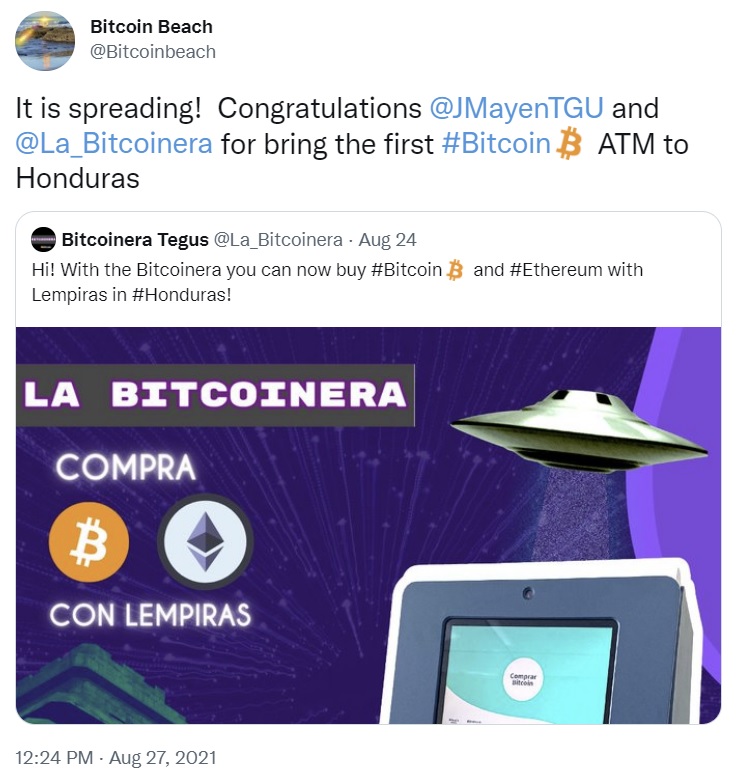
A cryptocurrency ATM has been installed in Honduras where users can buy bitcoin and ether. According to reports, this is the first crypto ATM in the country. Honduras borders El Salvador, where bitcoin is set to become legal tender in a little over a week.
Cryptocurrency ATM in Honduras
A cryptocurrency ATM launched this week in Honduras, Reuters reported Friday. According to reports, this is the first cryptocurrency ATM in the country. It allows users to buy bitcoin and ethereum using the local lempira currency.
The Republic of Honduras is a country in Central America. It borders El Salvador, the country which passed a law making bitcoin legal tender alongside the U.S. dollar. The law is set to go into effect on Sept. 7.
The cryptocurrency ATM in Honduras, locally called La Bitcoinera, was installed in an office tower in the capital of Tegucigalpa by Honduran firm TGU Consulting Group.
TGU CEO Juan Mayen, the 28-year-old CEO who led the crypto ATM effort, explained that there was no automated way to buy cryptocurrencies until now, stating:
You had to do it peer-to-peer, look for someone who … was willing to do it, meet in person and carry x amount of cash, which is very inconvenient and dangerous given the environment in Honduras.
The cryptocurrency ATM tracking website Coinatmradar does not currently list any cryptocurrency ATMs for Honduras.
Mayen said that he hopes to install more cryptocurrency ATMs. He noted that many software developers in the country are already paid in cryptocurrencies, emphasizing that using cryptocurrency will lower the cost of sending remittances.
In 2020, Hondurans living abroad sent $5.7 billion, about 20% of the country's gross domestic product (GDP), in remittances.
With the upcoming Bitcoin Law going into effect, El Salvador President Nayib Bukele said last week that 200 crypto ATMs are being installed.
Do you think Honduras should have more cryptocurrency ATMs? Let us know in the comments section below.
Image Credits: Shutterstock, Pixabay, Wiki Commons
Disclaimer: This article is for informational purposes only. It is not a direct offer or solicitation of an offer to buy or sell, or a recommendation or endorsement of any products, services, or companies. Bitcoin.com does not provide investment, tax, legal, or accounting advice. Neither the company nor the author is responsible, directly or indirectly, for any damage or loss caused or alleged to be caused by or in connection with the use of or reliance on any content, goods or services mentioned in this article.
Crypto Harry posted: " On Saturday, August 28, the non-fungible token (NFT) project Cryptopunks crossed $1 billion in all-time sales. Cryptopunks joins the heavyweight NFT hitters Axie Infinity's $1.6 billion and Opensea's $3.53 billion. Three NFT Projects "
On Saturday, August 28, the non-fungible token (NFT) project Cryptopunks crossed $1 billion in all-time sales. Cryptopunks joins the heavyweight NFT hitters Axie Infinity's $1.6 billion and Opensea's $3.53 billion.
Three NFT Projects Have Sold More Than a Billion-Dollars in Sales
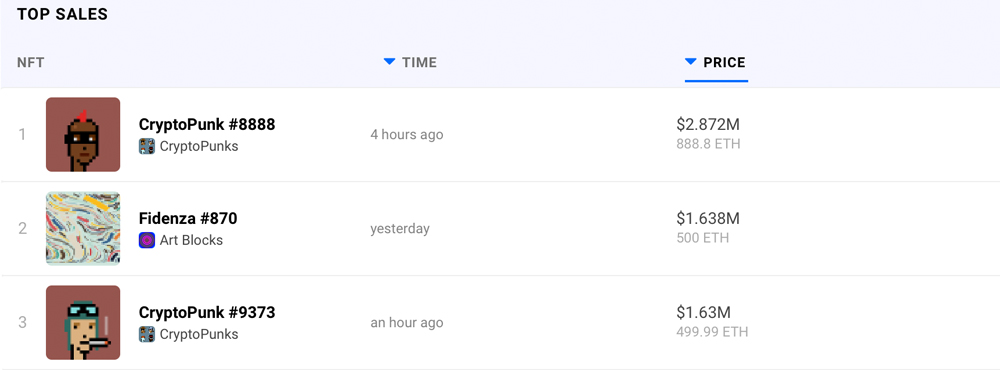
The non-fungible token project Cryptopunks is now a billion-dollar NFT collection as statistics show all-time sales tapped $1.095 billion, according to dappradar.com data. Cryptopunks has a bunch of records on dappradar.com's "top sales" page, in terms of NFT sales. Cryptopunks is just below Opensea ($3.54B) and Axie Infinity ($1.68B) in terms of all-time sales.
The biggest sale shown on August 28, is Cryptopunk #8888 which sold for 888.8 ether or $2.87 million. There's also Cryptopunk #9373 which sold for 499.99 ether on Saturday or roughly $1.63 million using ethereum (ETH) exchange rates at the time of sale.
Cryptopunk #2310 sold for 380 ETH or $1.23 million, Cryptopunk #9100 sold for 350 ether or $1.14 million, and Cryptopunk #7674 sold for 342.69 ether or $1.11 million on Saturday afternoon (ET).
According to nonfungible.com market stats, Cryptopunk is just below Artblocks this week in terms of sales. While Artblocks saw 24,454 sales which add up to $228 million, seven-day statistics show Cryptopunk saw only 686 sales but also saw $173 million settled.
One Entity Owns 254 Cryptopunks, NBA Top Shot Sales Taps $671 Million
There are 10,000 Cryptopunks minted and today, 2,888 unique wallets hold at least one Cryptopunk NFT. One entity owns a total of 254 punks and 75% of punk owners own at least two Cryptopunks. The project's sales across seven days have jumped 750% and Cryptopunks saw $144.605 million in sales among 343 traders.
In terms of all-time sales, Cryptopunks $1.095 billion is well above the rest of the projects listed on dappradar.com. NBA Top Shot has $671 million in all-time sales, Rarible has $197 million, and Superrare has $103 million on August 28.
What do you think about Cryptopunks tapping $1 billion in all-time sales? Let us know what you think about this subject in the comments section below.
Image Credits: Shutterstock, Pixabay, Wiki Commons, Cryptopunks, Larva Labs,
Disclaimer: This article is for informational purposes only. It is not a direct offer or solicitation of an offer to buy or sell, or a recommendation or endorsement of any products, services, or companies. Bitcoin.com does not provide investment, tax, legal, or accounting advice. Neither the company nor the author is responsible, directly or indirectly, for any damage or loss caused or alleged to be caused by or in connection with the use of or reliance on any content, goods or services mentioned in this article.
Crypto Harry posted: " President Alexander Lukashenko has advised workers to stay in their home country instead of emigrating to fill low-paid farming jobs in Poland and Germany. The Belarusian leader pointed to an alternative source of income, noting there"
President Alexander Lukashenko has advised workers to stay in their home country instead of emigrating to fill low-paid farming jobs in Poland and Germany. The Belarusian leader pointed to an alternative source of income, noting there's enough electricity in Belarus to power cryptocurrency mining.
Lukashenko Calls on Belarusian Workers to Build Mining Farms, Not Work at Foreign Farms
During a meeting at the state-owned enterprise JSC Belaruskali, one of the world's largest producers of potash fertilizers, Belarusian President Alexander Lukashenko urged employees to use the available surplus electricity to mine cryptocurrency. The head of state also remarked that Belarusian workers are not wanted abroad, except for farming jobs.
"We must understand, they are not waiting for us anywhere. And if someone is, it may be on the plantations," Lukashenko warned in a video posted by the Пул Первого Telegram channel. His speech was quoted by Forklog and the Russian business news portal RBC. Lukashenko said that guest workers are "squirming" in the strawberry farms of Poland and Germany.
The Belarusian leader visited Pietrykaw, a town in the southern Gomel region, where he also attended the opening ceremony of a mining and processing plant. In his address, the president pointed out that the area has a lot of empty industrial sites and called on his audience to use the available space and abundant energy to build greenhouses, for example. He then added:
Create something on electricity. In the end, start mining cryptocurrency or whatever it's called. There is enough electricity in the country.
Belarus legalized crypto-related business activities, including mining, with a presidential decree that went into force in March 2018. In April 2019, Alexander Lukashenko suggested that bitcoin farms could be built at the nuclear power plant in Grodno region on the Lithuanian border to utilize the surplus electrical energy produced by the NPP.
In November last year, the country's largest banking institution, Belarusbank, launched a service allowing users to buy and sell digital currencies with a Visa card. However, during a meeting with senior government officials in March this year, the Belarusian president hinted at tightening the regulatory framework to control the usage of cryptocurrencies, citing as an example China's experience in the building of a digital society.
Do you think the government in Minsk will actively facilitate the development of the crypto mining industry in Belarus? Tell us in the comments section below.
Image Credits: Shutterstock, Pixabay, Wiki Commons
Disclaimer: This article is for informational purposes only. It is not a direct offer or solicitation of an offer to buy or sell, or a recommendation or endorsement of any products, services, or companies. Bitcoin.com does not provide investment, tax, legal, or accounting advice. Neither the company nor the author is responsible, directly or indirectly, for any damage or loss caused or alleged to be caused by or in connection with the use of or reliance on any content, goods or services mentioned in this article.
Crypto Harry posted: "Home News Mobile Phones The iPhone 12. (Image credit: Future) If you own one of the iPhone 12 or iPhone 12 Pro models and you can't hear the person you're talking to on calls, Apple may repair or replace your handset for free under the terms o"
If you own one of the iPhone 12 or iPhone 12 Pro models and you can't hear the person you're talking to on calls, Apple may repair or replace your handset for free under the terms of a new service program that has just been introduced.
"Apple has determined that a very small percentage of iPhone 12 and iPhone 12 Pro devices may experience sound issues due to a component that might fail on the receiver module," Apple states in a support document.
According to Apple, affected devices were manufactured between October 2020 and April 2021. The fault has not been spotted in iPhone 12 mini and iPhone 12 Pro Max models, so they're not included in this particular program.
To get your iPhone looked at, you can get in touch with Apple Support, go to an Apple Store, or visit an authorized Apple service provider – see here for details. iPhones "will be examined prior to any service to verify that it is eligible for this program" Apple says.
In order to qualify for the program, you must have bought your iPhone 12 or iPhone 12 Pro within the last two years – so if your handset is fine now but develops problems in the future, you can still get a free service from Apple as long as those two years aren't up.
Opinion: service programs show Apple can be relied upon
The iPhone 12 Pro. (Image credit: TechRadar)
When you're buying an item of hardware from Apple, you'll often find you're paying more than you might pay for something of the equivalent spec from another manufacturer – but service programs like the one just launched for the iPhone 12 and the iPhone 12 Pro show how your purchasing decision should be about more than just how much you're paying.
If you were critical, you might say that these service programs reveal the shoddy workmanship and quality control at Apple's suppliers, but nevertheless it is reassuring that when a problem is identified, Apple is usually quick to swing into action.
And these service programs couldn't be any more straightforward to make use of: you can put your device in the post, take it into an Apple Store, or deal with one of the authorized service partners that Apple works with, all without paying any money.
Apple has certainly made missteps in the past – not least with the poorly thought through butterfly keyboard design that it previously used on its MacBooks, which wasn't acknowledged as faulty for a long time – but generally speaking, the occasional appearance of these service programs is going to give buyers more confidence.
Dave is a freelance tech journalist who has been writing about gadgets, apps and the web for more than two decades. On TechRadar you'll find him covering news, features and reviews, particularly for phones, tablets and wearables.
Crypto Harry posted: "Home News Computing (Image credit: Shutterstock / Blanscape) The Central Japan Railway Company has revealed it is building dedicated video conferencing carriages for its famous bullet trains, in an effort to better service its business custome"
The Central Japan Railway Company has revealed it is building dedicated video conferencing carriages for its famous bullet trains, in an effort to better service its business customers.
Although Wi-Fi is already available on bullet train services, the new "S-Work" carriages will offer double the connection speed, which should ensure customers can hold calls with minimal disruption.
The seats will also be equipped with power outlets to help keep devices topped up, and the railway company even says it will loan out mice, privacy screens and laptop pillows on request.
To make space for the new carriages, the firm will retire its old smoking-friendly cars, which no longer serve a purpose after a country-wide ban on smoking on trains came into effect last year.
In some instances, booths previously set aside for smokers will also be replaced with privacy pods, for workers who would prefer not to be overheard by fellow passengers.
(Image credit: Central Japan Railway Company)
Video conferencing at 300km/h
Initially, the work-friendly carriages will be available on only two routes (between Tokyo and Nagoya, and Tokyo and Osaka) and only on a specific type of bullet train: the N700S.
A translation of the promotional website suggests an S Work ticket between Tokyo and Osaka will cost 14,520 yen (roughly $130), with discounts available if booked in advance. As usual, prices will also fluctuate between busy and quiet seasons.
As a condition of travel, children will not be allowed to accompany business travelers and passengers are required to work as quietly as possible (that means you, loud typists) to help others concentrate on their work and/or meetings.
Although the website is somewhat unclear, partly due to translation issues, the S Work carriages appear set to make their debut in mid-October.
Joel Khalili is a Staff Writer working across both TechRadar Pro and ITProPortal. He's interested in receiving pitches around cybersecurity, data privacy, cloud, storage, internet infrastructure, mobile, 5G and blockchain.
Crypto Harry posted: "Home News Entertainment (Image credit: Warner Bros.) Thanks to the success of the Marvel Cinematic Universe, interlinking superhero franchises are all the rage right now. Their closest competitor is Warner Bros' DC Extended Universe, but in re"
Thanks to the success of the Marvel Cinematic Universe, interlinking superhero franchises are all the rage right now. Their closest competitor is Warner Bros' DC Extended Universe, but in reality it's not that close. There have been more lows than highs for Superman and company on the big screen in recent times, and it's undeniable that the DCEU is a lot messier than it should be 11 films in.
The upcoming Flash movie – which will reportedly be adapting elements from the popular Flashpoint comic book arc that reset the universe – may help remedy that. But with The Suicide Squad having recently landed in theaters, now is as good a time as any to look back on the bad, the good, and the great of DC's live action offerings over the past eight years.
The jury is still out on whether or not we'll get to see David Ayer's purported cut of Suicide Squad (though it seems unlikely). But the movie that was released in 2016 was a terrible, badly edited mess. The reason for the squad assembling in the first place is nonsensical, the villains-become-family arc is unearned, and the performances by Jared Leto as The Joker and Cara Delevigne as The Enchantress are among the worst in the genre.
The lone saving grace is in the casting of Margot Robbie as Harley Quinn and Viola Davis as Amanda Waller, two characters who show up in the sequel. But not even they, along with the charisma machine that is Will Smith, can save this one.
10. Justice League (2017)
(Image credit: Sky)
The biggest problem with 2017's Justice League is that it's the product of two different visions colliding. When Zack Snyder left the project due to personal tragedy, WB brought in Joss Whedon to finish the project. The results weren't pretty, from humor that felt forced and at times inappropriate to visuals that looked flat-out ugly.
The audience were left unsatisfied, and it's become clearer and clearer in recent times that the actors who worked on the movie weren't happy either, with Cyborg actor Ray Fisher accusing Whedon of "gross, abusive, unprofessional, and completely unacceptable" conduct. Gal Gadot shared her own story about the experience, too. The first live action team-up of DC's most iconic heroes deserved much better.
8. Batman v Superman: Dawn of Justice
(Image credit: Warner Bros/DC Entertainment)
Batman v Superman: Dawn of Justice is what you get when the writers and director don't understand what makes their titular characters special. Doubling down on the broody Superman established in Man of Steel is bad enough. But turning Batman into a killing machine is a choice so incompatible with the character that it breaks the world of the film (why would Commissioner Gordon still light the Bat-signal if Gotham's famous vigilante was dropping bodies? He should be hunting him down).
One of the few bright spots in all the doom and gloom is the introduction of Gal Gadot's Wonder Woman, who makes a fun splash in the final battle against Doomsday.
8. Wonder Woman 1984
(Image credit: Warner Bros)
The first 20 minutes of Wonder Woman 1984 – in which we see a young Diana compete in a Themyscirian Olympics, and then watch as Gal Gadot's lasso-wielding heroine take down a group of robbers in 1984 – are incredible. Unfortunately, the rest of the film is a bit middling. With the hunt for a MacGuffin, two villains, and the return of Steve Trevor (under icky circumstances that are never really examined), there are ultimately too many spinning plates for this sequel to satisfyingly service.
Still, there is plenty to like here. Chris Pine and Gadot remain a charming double act, and Pedro Pascal and Kristen Wiig both acquit themselves well as Maxwell Lord and Barbara Minerva/Cheetah respectively. And as heavy-handed and cheesy as it is, the earnestness of the movie is hard to dislike.
7. Zack Snyder's Justice League
(Image credit: HBO Max/Warner Bros.)
Zack Snyder's Justice League benefits from a unified vision that the 2017 cut didn't have. For one thing, character decisions make more sense and the chemistry between the team is more pronounced. For another, the beefed up Cyborg storyline is complex and emotional.
But some of the problems when it comes to Snyder's vision for these characters still remain, and there's at least 20 minutes of unnecessary footage that could and should have been excised from this four-hour cut. No one needs to hear an extended Icelandic ballad in a Justice League movie.
6. Man of Steel
(Image credit: Warner Bros)
There is so much about Man of Steel that works. Superman's first flight sequence is an all-timer, and his suit looks great. Hans Zimmer's score is markedly different from John Williams' standard setting work in the 1970s, but no less stunning. We can even get on board with the 20 minute prologue in which Russell Crowe's Jor-El rides a lizard with dragonfly wings. But this counts for little if you don't get the core tenets of Kal-El right.
And even before the Man of Steel snaps Zod's neck in the final battle, there are signs that the filmmakers behind this interpretation of Superman weren't nailing the simple things (for one thing, if your name isn't Lois Lane, you're probably not getting saved in this movie). It's a shame, because with the right script Henry Cavill could have really done something special with this character. But he, and we, are still waiting for it.
5. Aquaman
(Image credit: Warner Bros.)
How to stop people thinking that Aquaman is a joke? Step 1: Cast Jason Momoa. The once and former Khal Drogo brings his unique energy to the role, and it works a treat. Whether he's taking down villains on a submarine or bouncing off of Amber Heard's Mera, he's always fun to watch. Step 2 is hiring James Wan.
When Aquaman leans into its fantasy elements, the visuals are often spectacular. The film loses points for not utilizing Yahya Abdul-Mateen II's Black Manta enough, and a few more for some really strange soundtrack choices that feel like they belong in another movie. But overall, we're definitely laughing with the King of the Seas rather than at him. Bring on Aquaman 2.
4. Shazam!
(Image credit: Warner Bros)
In its best moments, Shazam! has an excellent balance of humor and heart. The central conflict of blood family vs. foster family is given the right amount of weight, and the film gets a lot of mileage out of the idea that a teenager can transform into a muscle-clad superhero with just one word.
David F. Sandberg's movie can also lay claim to having the best joke in the entirety of the DCEU to date, in which Mark Strong's villain try to monologue to a hero who can't hear him. At times it feels a bit too lighthearted, with jokes that undercut genuine emotion at the wrong times. But with fun performances, a great message, and an exciting setup for the sequel, this film set the stage for characters I can't wait to see more of.
3. Wonder Woman
(Image credit: Warner Bros)
After the back-to-back-to-back disappointments of Man of Steel, Batman v Superman: Dawn of Justice, and Suicide Squad, the DCEU desperately needed a win, and thanks to director Patty Jenkins they got it with Wonder Woman.
The No Man's Land sequence – in which Diana strides confidently across the battlefield deflecting bullets while Rupert Gregson-Williams' score soars – is still the best 2 minutes of the DCEU to date. Add that to a beautifully visualised first act that focuses on the warrior women of Themyscira and the instantly winning chemistry between Gadot and Pine's Steve Trevor, and only some third act problems hold it back from a higher placing on this list.
2. Birds of Prey: The Fabulous Emancipation of one Harley Quinn
There are no such third act issues with Birds of Prey – in fact, it might be the best thing about a movie, a riotous action sequence in which a hair clip is exchanged mid-battle proving to be one of many highlights. There's lots to like before that inevitable throw-down too, much of it do to Margot Robbie's pitch-perfect performance of Harley Quinn.
Freed from Jared Leto and The Joker, she truly makes the character her own with this movie, from Quinn's mannerisms to her attitude. Throw in a fantastic Daniel Pemberton score and a supporting cast who do a lot with a little (Mary Elizabeth Winstead is especially fun here as The Huntress), and you have one of the DCEU's best films.
1. The Suicide Squad
(Image credit: Warner Bros.)
The Suicide Squad debacle of 2016 didn't exactly have people hankering for more movies focused on Task Force X. That all changed when James Gunn got hired to write and direct a sequel.
Having made two movies about the MCU's Guardians of the Galaxy, Gunn had form when it came to making us fall in love with a group of rogues, and he proves it again here. There's just the right balance of humor, character, and action, with multiple third act payoffs and a body count that remembers what the title of the movie is. Put simply… he understood the assignment.
Crypto Harry posted: "Home News (Image credit: Shutterstock / Wit Olszewksi) A pivotal moment took place in the crypto industry four years ago, on August 1st, 2017, when the Bitcoin (BTC) network split into two and each holder of BTC received an equal amount in "
A pivotal moment took place in the crypto industry four years ago, on August 1st, 2017, when the Bitcoin (BTC) network split into two and each holder of BTC received an equal amount in a new cryptocurrency – Bitcoin Cash (BCH). The new cryptocurrency had real value, costing as much as $400 per coin. The opportunity of getting some free cash in such a manner would herald the launch of a slew of forks. But avarice and the lust for profiteering have no place in this Bitcoin spinoff.
The pains of aging
Anything that can go wrong, will go wrong.
Murphy's Law
The fact is that Bitcoin was becoming popular as its value grew and the number of users increased along with the volume of transactions they made. Confirmation times and transaction costs also increased, eventually impeding the development of the world's first digital currency. No one would be willing to buy a cup of coffee using Bitcoin if they had to pay a commission double the cup's price. In addition, the merchants were not prepared to wait for days for transaction confirmation. All these issues called into question the use of Bitcoin as a means of payment.
Bitcoin ended up implementing a technology called SegWit in an attempt to reduce transaction fees. In one sense, it has succeeded. Fees are slightly cheaper than they would otherwise be without SegWit. However, adoption of SegWit has continued for years. Even with perfect adoption, bitcoin fees remain too high for normal cash transactions.
"Today BCH is closer to the Bitcoin that Satoshi Nakamoto created, than the coin we call BTC today."
Amaury Sechet, BCH Developer & Creator
In fact, there were two solutions and both were implemented, leading to the fork. The problems related to commissions and transaction confirmation times were solved, without the complication of SegWit, by increasing external storage space. Such a solution was overall more natural and consistent with the real Bitcoin.
Four years ago, the crypto community got another new Bitcoin and the new Bitcoin Cash, which was similar to the original Bitcoin by Satoshi. The goals that had triggered the dispute and resulted in the fork were not achieved, because neither BTC nor BCH became a means of payment like fiat currency, although BTC was formally recognized by El Salvador as on par with the US dollar.
Amaury Sechet, the founder of the eCash project and a benevolent dictator (as he calls himself), was at the heart of the events that took place four years ago. Today, eCash represents the continuation of Bitcoin's development, combining the best aspects of BTC, BCH and BCHA. I like to entertain a degree of hope that Sechet will be able to attain the goals those projects had set for themselves.
The solutions of the dictators
Satoshi Nakamoto has never been a democrat. That is how he managed to create Bitcoin. Then Satoshi left and Bitcoin started stomping on the spot.
Amaury Sechet, BCH Developer & Creator
The history of the development of Bitcoin and the formation of this cryptocurrency as the first digital form of cash does not end with the events that had taken place four years ago, as described above. We can say that development has never really stopped and sometimes tough and unpopular decisions have been required, and have had to be made by only one person.
Satoshi Nakamoto faced such problems in the past, and Amaury Sechet faces the same problems today. At first glance, making decisions single-handedly in a decentralized project may seem like a dubious idea, but that actually helps achieve traction.
Amaury Sechet, the founder of the eCash project and a benevolent dictator (as he calls himself), was at the heart of the events that took place four years ago. Today, eCash represents the continuation of Bitcoin's development, combining the best aspects of BTC, BCH and BCHA. I like to entertain a degree of hope that Sechet will be able to attain the goals those projects had set for themselves.
The future of digital cash
Digital cash will become the currency of the future, just as fiat is the currency of today. It will become an integral instrument of the economy. It is also likely that the migration to digital currency will not just involve the digitization of cash, but will continue on to attain such levels of progress that would be comparable with the transition from horsepower to the internal combustion engine.
I like to believe that such digital cash will be reliable, protected from inflation and convenient in everyday use, and it should also be built on the basis of a near-perfect and scalable technology that can go global.
With digital cash as its surfboard, the future would become unstoppable, even if central banks are capable of impeding their spread until the development and launch of state digital currencies. Only time will tell which digital form of cash will become dominant – alternative coins, BTC, or an iteration of some state-issued "digital yuan".
Crypto Harry posted: "Home News Computing (Image credit: Nvidia) Nvidia's next-gen graphics cards, purportedly codenamed Lovelace, might be here earlier than expected in 2022, and could be built by TSMC on a 5nm process, or so the latest rumor reckons.This comes fr"
Nvidia's next-gen graphics cards, purportedly codenamed Lovelace, might be here earlier than expected in 2022, and could be built by TSMC on a 5nm process, or so the latest rumor reckons.
This comes from well-known hardware leaker Kopite7kimi on Twitter, who replied to a comment about the incoming GPUs arriving late in 2022 if they are actually on TSMC 5nm (and being expensive, too).
As Wccftech, which spotted this tweet, points out, the leaker had previously said that what will presumably be RTX 4000 graphics cards would be built on a 5nm process, but the assumption was that Nvidia could stick with Samsung for making Lovelace chips. Now Kopite7kimi has clarified that it'll purportedly be TSMC, and this backs up what we've heard in recent times from another leaker – namely Greymon.
Greymon has theorized that Lovelace GPUs could be made on TSMC 5nm or maybe even an enhanced 5nm process ('N5P') which would offer an even better performance leap from Ampere.
Analysis: Fingers crossed for an earlier release – but what about those prices?
Remember, these are pretty airy rumors at this stage, but the fact that more than one source is now saying TSMC 5nm does suggest that maybe this is the route Nvidia will indeed take. It's also possible that only certain models of RTX 4000 cards will be made at TSMC, and other chips could be manufactured at Samsung.
Whatever the case, it's good to hear that Kopite7kimi believes that we won't be waiting until late 2022, and that the next-gen graphics cards could arrive a bit earlier in the year. Particularly as previously, Greymon seemed to quite firmly assert that these cards wouldn't pitch up until the close of 2022 at best.
Fingers crossed that we could see RTX 4000 cards sooner than expected, perhaps, although it wouldn't be a surprise if these new models were seriously pricey, as the original tweet Kopite7kimi replied to suggested.
That's very much the direction that the GPU industry has been headed, of course, but hopefully the extra pressure that stock shortages have been putting on pushing prices upwards will ease as we get to a better place in terms of component supply throughout 2022.
That said, another recent rumor indicated that graphics cards could get more expensive at the beginning of next year, interestingly with this theoretically being driven by TSMC upping its prices (responding to the huge demand for its chips). Which, if it pans out, would be an argument for Nvidia not switching to TSMC you would think – or perhaps only using it for certain models like maybe the cutting-edge flagship.
Darren is a freelancer writing news and features for TechRadar (and occasionally T3) across a broad range of computing topics including CPUs, GPUs, various other hardware, VPNs, antivirus and more. He has written about tech for the best part of three decades, and writes books in his spare time (his debut novel - 'I Know What You Did Last Supper' - was published by Hachette UK in 2013).




































No comments:
Post a Comment